Uxzariqo
Frame Guide
Frame Guide
Couldn't load pickup availability
1. Problem Statement
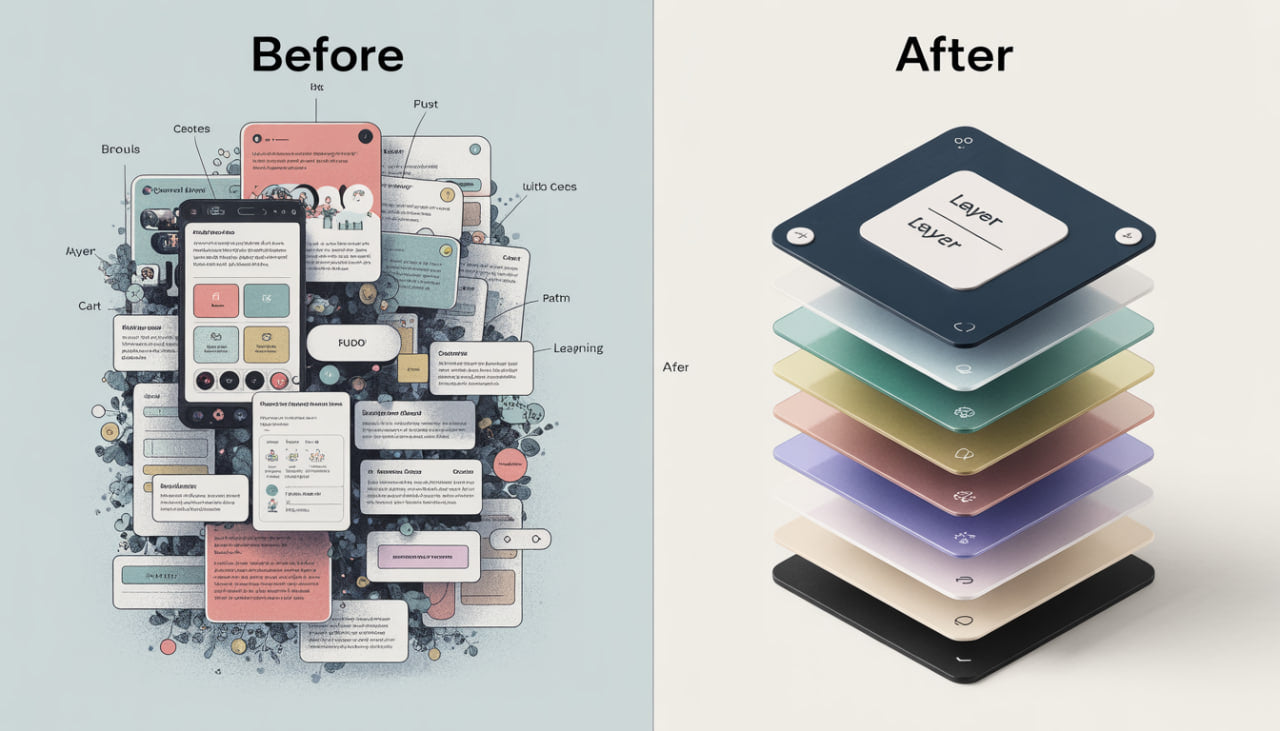
Many designers struggle with the balance between page density and white space, which creates visual chaos. Without a clear framing system, content often appears disjointed, and the user loses their bearings during interaction. Incorrect use of boundaries and spacing leads to an interface appearing either overcrowded or, conversely, too empty. A lack of understanding regarding proportions prevents the creation of harmonious layouts that look cohesive across various screens. The deficiency of methodology in block construction forces designers to spend significant time chaotically moving objects in search of the correct position.
2. Solution
We have developed a system of steps that helps implement discipline in the construction of every block in your layout. Our materials explain the logic of creating compositional frames that hold the interface structure together under any conditions. You will learn to use mathematical proportions and rhythm to create a sense of stability and order. This approach allows for the creation of solutions where every millimeter of space works toward clarity and convenience. These lessons will become a helpful tool for building complex systems that remain easy to perceive.
3. What's Inside (Detailed)
This learning level contains deep theoretical and practical resources for working with structure:
- Compositional Frame Logic: A detailed analysis of how to create invisible boundaries that guide the eye and keep focus on what is important.
- Modular Grid System: Resources for building complex grids that help organize large amounts of information.
- Proportions and Relationships: Studying how to use geometric principles to calculate block sizes and the distances between them.
- Working with Negative Space: Materials on how to make empty space an active design element that helps content "breathe."
- Block Construction Methodology: Step-by-step instructions for creating universal containers for different data types.
- Visual Rhythm and Repetition: Resources for understanding how the cyclical nature of elements helps users navigate the interface faster.
- Adaptive Principles: A guide on how to maintain compositional integrity when changing the format and size of the workspace.
- Practical Balance Exercises: Tasks that help develop skills in aligning and distributing objects within a space.
- Structural Scheme Library: A set of ready-to-use compositional models that can serve as a foundation for building new pages.
4. Who is this for?
The materials are designed for those who aim to move beyond simply copying others' solutions and want to understand the internal architecture of design. The course will be helpful for specialists working on multi-page projects and complex interfaces where order is critical. If you want your layouts to look confident and systematic, these lessons will provide you with the necessary base. This learning is suitable for anyone who values precision, mathematical logic, and clarity in visual solutions.
5. What You'll Learn
- Develop skills in building stable compositional systems.
- Use modular grids to organize complex content.
- Apply proportionality principles to create harmonious blocks.
- Improve interface structure through correct spacing management.
- Form visual rhythm that facilitates information perception.
- Create adaptive layouts that maintain logic on any device.
- Build a clear hierarchy through the use of space and boundaries.
6. Review Policy
You can review all course sections for 30 days without any risks. We aim to provide materials that truly bring value, which is why we offer this period to evaluate the quality and structure of our lessons. If you feel that this approach does not meet your needs, you have the option to receive a refund. Our goal is to ensure a comfortable and open path to new knowledge for every Uxzariqo user.
Self-paced learning overview
- 📦 Digital file available after purchase
- ♾️ Long-term availability
- 🔒 Secure checkout
- 🔄 Content updated in 2026
Are the materials available immediately after choosing a course?
Are the materials available immediately after choosing a course?
Yes, all learning resources become available in your personal account on the online platform immediately after order confirmation. You can start studying the materials at your convenience, as we provide lifetime availability to the chosen modules.
What resources will I need for learning?
What resources will I need for learning?
To effectively master the materials, you will need any modern tool for working with interfaces and a stable internet connection. We have developed the lessons to be universal and suitable for use in various design environments.
Are these lessons suitable for those just starting their journey?
Are these lessons suitable for those just starting their journey?
Our materials are structured from simple to complex, making them helpful for users with different preparation levels. Each section contains detailed explanations that help build a knowledge base steadily without unnecessary strain.
Share